
LEARN. DO. CO-CREATE
 Travel and Tourism Development Index in RA (2026)
The study of indicators and indices published by international organizations allows to address two important problems. First, to assess the performance of the RA in the given period with the help of comprehensive numerical measures, as well as to make intertemporal comparisons in order to understand whether the country moves in the desirable direction. Second, to compare the performance of the RA with other countries to ascertain Armenia’s relative position in the region and Eurasian Economic Union. These results are important, since they help to derive the comprehensive assessment of the economic situation, which is needed both for the public and the private sector. The present analysis is aimed at addressing the foregoing problems. Full material is only available in Armenian.

 The social-economic developments in the economy of the RA for January-August 2026
In the present analysis, given the data published by the Statistical Committee of the RA, we study the recent social-economic developments in the economy of the RA. In particular, we consider the cumulative indicator of economic activity of the given month, its sectoral distribution, as well as the dynamics of individual sectors of the economy. We also analyze economic developments in the foreign trade, labour market and fiscal system of the RA. In addition, some aspects of the financial system (inflation, deposits and loans), as well as the behaviour of the exchange rate, are touched upon. Full material is only available in Armenian.
 Global Gender Gap Index in the RA (2026)
The study of indicators and indices published by international organizations allows to address two important problems. First, to assess the performance of the RA in the given period with the help of comprehensive numerical measures, as well as to make intertemporal comparisons in order to understand whether the country moves in the desirable direction. Second, to compare the performance of the RA with other countries to ascertain Armenia’s relative position in the region and Eurasian Economic Union. These results are important, since they help to derive the comprehensive assessment of the economic situation, which is needed both for the public and the private sector. The present analysis is aimed at addressing the foregoing problems. Full material is only available in Armenian.
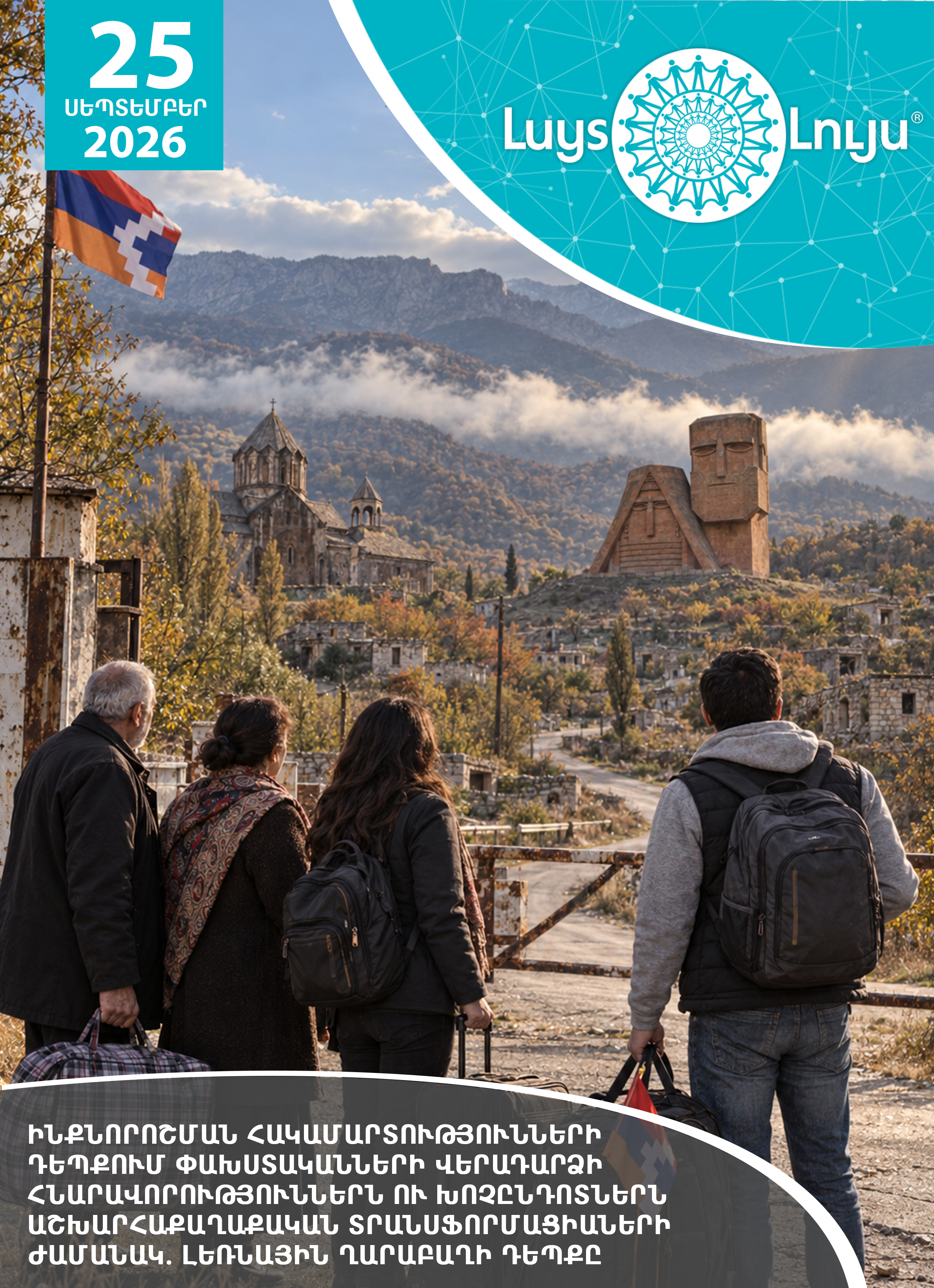 The possibilities and problems of refugee return in self-determination conflicts during geopolitical transformations: The case of Nagorno-Karabakh.
The realization of the right to return for refugees within the framework of international law remains one of the most difficult and often intractable problems, especially in Eurasian regions that often- become arenas for geopolitical conflict. The situation is further complicated when refugees are forcibly expelled from their homes with the use of military force or crimes against humanity, such as ethnic cleansing and genocide, during conflicts over self-determination. This process occurs during an acute phase of geopolitical transformation, when influential States violate the fundamental norms and principles of international law themselves and engage in redistribution of influence. Metropolises often attempt to resolve conflicts through military aggression, ethnic cleansing and genocide displace a self-determined people from their territory of residence. In this case, the right of refugees to return, who have escaped extermination, is considered not only as a personal right for each of them but also as an opportunity for exercising their collective right to self-determination, when the entire nation or a significant part thereof has become refugees. The article considers the solution to this complex interdisciplinary problem in a combination of legal and political components, in order to determine what opportunities and obstacles exist for the return of refugee populations. First, the legal basis for returning refugees within the context of international law is discussed. Then, based on three cases of conflicts over self-determinations (East Timor, Kosovo, and Western Sahara), a comparative analysis is performed of various outcomes for returning refugees (successful, partially successful, and unsuccessful). Based on the results of a comparative study of these cases, an attempt is being made to model which factors determine the success of return. To assess the effectiveness of this research tool, the possibility of the influence of these factors on the return of refugees from Nagorno-Karabakh is analyzed. Full material is only available in Armenian.
 The social-economic developments in the economy of the RA for January-July 2026
In the present analysis, given the data published by the Statistical Committee of the RA, we study the recent social-economic developments in the economy of the RA. In particular, we consider the cumulative indicator of economic activity of the given month, its sectoral distribution, as well as the dynamics of individual sectors of the economy. We also analyze economic developments in the foreign trade, labour market and fiscal system of the RA. In addition, some aspects of the financial system (inflation, deposits and loans), as well as the behaviour of the exchange rate, are touched upon. Full material is only available in Armenian.
 On the execution report of the state budget of the RA for the first half of 2026
The objective of the present analysis is to assess the execution of the state budget of the RA in the given period. First, we describe the general state of the economy of the RA, namely the driving forces of economic activity, the developments in individual sectors of the economy, the behavior of the components of the demand – consumption and investment – and so on. Afterwards, we analyze the performance of government revenues and expenditures by comparing the actual and planned values of the respective indicators. We conclude the analysis by summarizing the main observations and results. Full material is only available in Armenian․
 The social-economic developments in the economy of the RA for January-June 2026
In the present analysis, given the data published by the Statistical Committee of the RA, we study the recent social-economic developments in the economy of the RA. In particular, we consider the cumulative indicator of economic activity of the given month, its sectoral distribution, as well as the dynamics of individual sectors of the economy. We also analyze economic developments in the foreign trade, labour market and fiscal system of the RA. In addition, some aspects of the financial system (inflation, deposits and loans), as well as the behaviour of the exchange rate, are touched upon. Full material is only available in Armenian.
 Expert Opinion on the Constitutionality of Constitutional Law No. HO-275-N of 3 July 2026 On Amendments and Additions to the Constitutional Law on the Rules of Procedure of the National Assembly
This expert opinion examines the constitutionality of Constitutional Law No. HO-275-N of 3 July 2026 amending the Constitutional Law on the Rules of Procedure of the National Assembly of the Republic of Armenia.
The opinion argues that, although the legislation pursues the constitutionally legitimate objective of ensuring the continuity of parliamentary functioning, the legal mechanisms chosen to achieve that objective are incompatible with the Constitution of the Republic of Armenia. It demonstrates that the new provisions enable the parliamentary majority to block, through repeated voting, the election of candidates nominated by the opposition, thereby effectively neutralizing the institutional guarantees established by Articles 104 and 106 of the Constitution.
The study offers a systematic interpretation of Articles 88, 89, 104, and 106 of the Constitution, analyses the legal reasoning of Constitutional Court Decision DCC-1708, and concludes that the contested amendments do not implement that judgment but instead reproduce, in a different legislative form, the very constitutional defect identified by the Court. The opinion concludes by identifying the specific provisions of the law that are incompatible with the Constitution. Full material is only available in Armenian.
 Medium-term public expenditure framework for 2027-2029
The primary document that defines the medium-term (that is, for the upcoming three years) objectives of the government of the RA is the framework of public medium-term expenditures (MTEF), which is at the same time one of the main tools for fiscal policy communication. The effective use of the MTEF for that purpose is especially important in both crisis and post-crisis periods, as it can give policy signals to economic agents, positively affect expectations and decrease the uncertainty in the economy. The present analysis is aimed at exploring the MTEF for 2027-2029, in particular the structure of the program, the main macroeconomic forecasts and directions of fiscal policy, which reflect the government's expectations regarding the further development of the economic situation as well as government actions to ensure a rapid economic recovery. Full material is only available in Armenian.
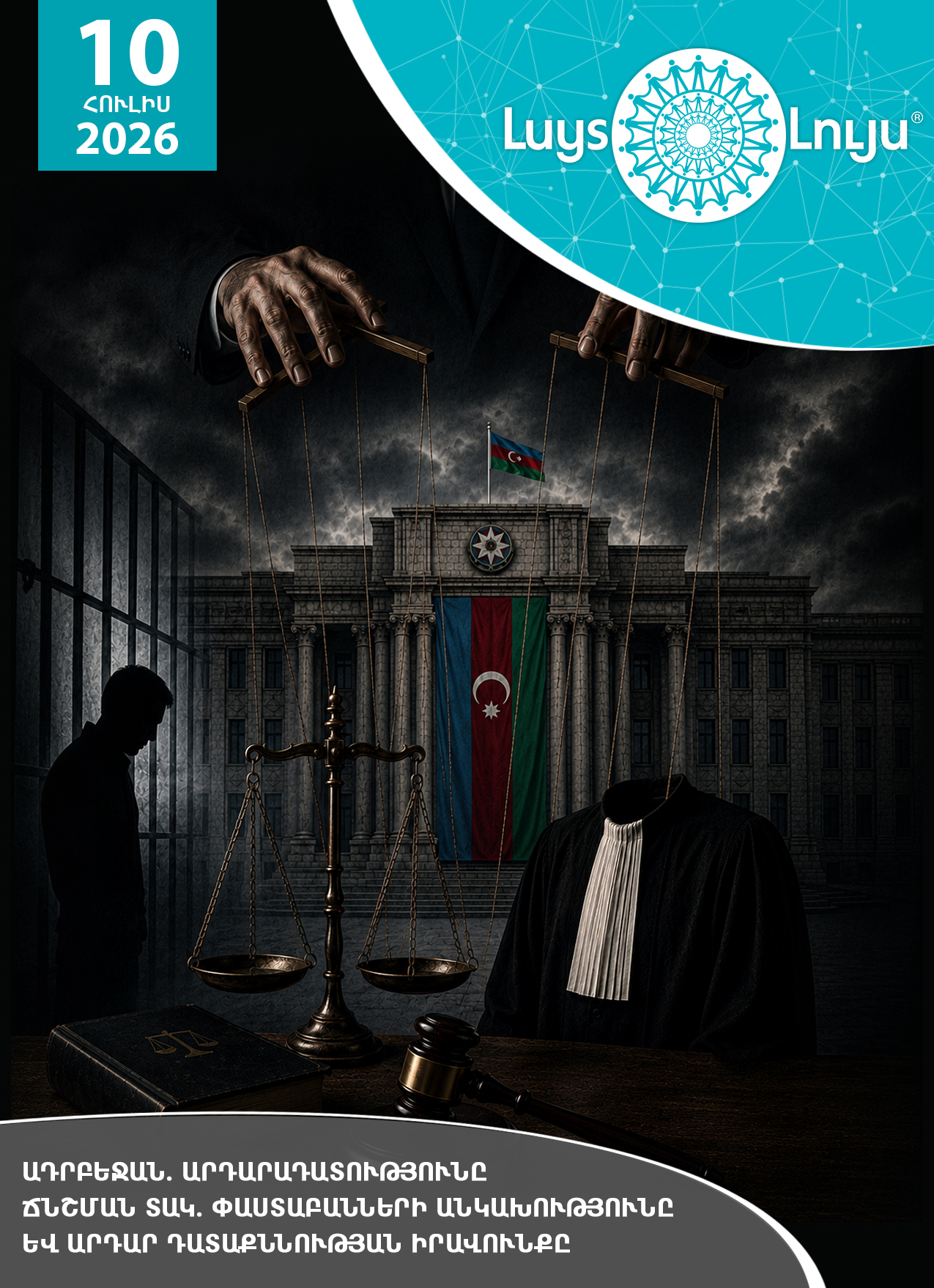 Azerbaijan: Justice Under Pressure. Independence of Lawyers and the Right to a Fair Trial
This publication presents the Armenian translation of Chapter IV of the report "Azerbaijan: Justice Under Pressure. Independence of Lawyers and the Right to a Fair Trial", published by the International Commission of Jurists (ICJ) on 29 June 2026.
The report provides a comprehensive legal assessment of the criminal proceedings conducted by Azerbaijan against Armenian prisoners of war, civilian detainees, and former officials of Nagorno-Karabakh. Rather than examining these proceedings as isolated cases, the ICJ places them within the broader context of long-standing structural deficiencies in Azerbaijan's criminal justice system.
The primary focus of this publication is Chapter IV, "Courts and the Right to a Fair Trial," in which the ICJ assesses the compatibility of these proceedings with international fair trial standards. To provide the necessary context, the publication also includes a concise overview of the report's first three chapters, highlighting the structural factors underlying the Commission's legal conclusions.
Alongside the Armenian translation, a link to the official English version of the report is also provided for readers who wish to consult the original text. Full material is only available in Armenian.